Heritage Places in Bengaluru: Discovering the City’s Living History with Make It Happen
When most people think of Bengaluru, they picture a thriving technology hub, bustling cafés, and modern urban life. Yet beneath the city’s contemporary identity lies a fascinating tapestry of stories, architecture, communities, and traditions that have evolved over centuries. Exploring the heritage places in Bengaluru offers a completely different perspective of the city, revealing layers of history that often go unnoticed amidst the fast-paced growth.
From ancient temples and royal palaces to colonial-era neighborhoods and traditional marketplaces, Bengaluru’s heritage is not confined to monuments alone. It lives in its streets, its food, its communities, and the memories passed down through generations. At Make It Happen, we believe that heritage is best experienced through stories and local connections, allowing visitors to understand not just what they are seeing, but why it matters.
Understanding Bengaluru’s Historical Journey
The story of Bengaluru stretches back much further than its reputation as India’s Silicon Valley. Historical records indicate that the region has been inhabited for over a thousand years. The city’s modern foundation is often associated with Kempegowda I, a feudal ruler under the Vijayanagara Empire, who established Bengaluru as a fortified town in 1537.
Over the centuries, the city witnessed the influence of the Vijayanagara rulers, the Wodeyars of Mysore, Hyder Ali, Tipu Sultan, and later the British administration. Each period left a distinct imprint on the city’s architecture, culture, and urban planning.
This layered history is what makes the heritage places in Bengaluru particularly fascinating. Unlike cities defined by a single era, Bengaluru reflects multiple historical periods coexisting within a modern metropolis.
Bangalore Fort: A Window into the City’s Origins
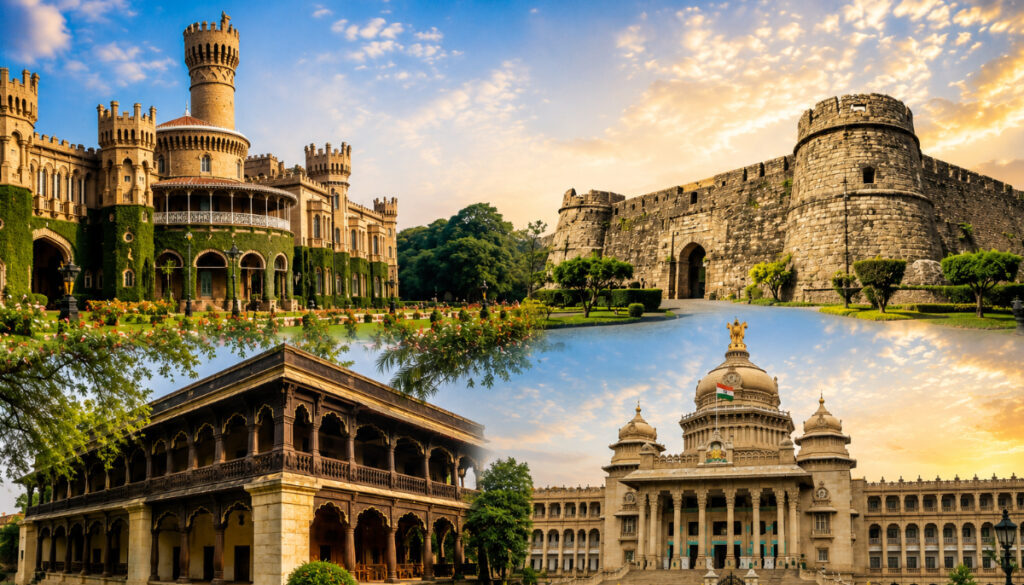
Among the most significant heritage places in Bengaluru is Bangalore Fort. Originally built as a mud fort by Kempegowda in the 16th century, it was later strengthened in stone by Hyder Ali during the eighteenth century.
Although only portions of the fort survive today, the structure offers valuable insights into the city’s early strategic importance. Walking through the surviving gateway allows visitors to imagine Bengaluru as a fortified settlement long before it became a global technology center.
The fort also serves as a reminder of the political and military struggles that shaped southern India during the period of Mysore’s rise under Hyder Ali and Tipu Sultan.
Tipu Sultan’s Summer Palace: Elegance in Teak
Located near the fort is one of Bengaluru’s most iconic landmarks, Tipu Sultan’s Summer Palace.
Built primarily from teak wood, the palace showcases Indo-Islamic architecture characterized by ornate arches, intricately carved pillars, and elegant balconies. Historical accounts suggest that Tipu Sultan used the palace as a summer retreat and administrative center.
What makes the palace remarkable is not merely its architecture but its ability to transport visitors into the world of eighteenth-century Mysore. The building reflects both artistic sophistication and political ambition during a period when the kingdom was one of the most powerful forces in southern India.
For history enthusiasts, it remains one of the essential heritage places in Bengaluru.
Basavanagudi: Where Tradition Still Thrives
Not all heritage is monumental. Some of the city’s most meaningful heritage survives in living neighborhoods.
Basavanagudi is one such example. Established in the late nineteenth century, it remains one of Bengaluru’s oldest planned localities. The neighborhood derives its name from the famous Bull Temple, dedicated to Nandi, the sacred bull associated with Lord Shiva.
Walking through Basavanagudi reveals a unique blend of tradition and continuity. Tree-lined avenues, historic homes, age-old eateries, educational institutions, and bustling markets collectively tell the story of Bengaluru’s evolution during the princely state era.
The area is also known for preserving cultural practices, festivals, and culinary traditions that continue to shape local identity today.
Malleshwaram: A Neighbourhood Shaped by Tradition and Maratha Influence
While Malleshwaram is widely known for its tree-lined avenues, traditional homes, and vibrant cultural life, it also carries an often-overlooked connection to the Maratha presence in Bengaluru’s history. During the 17th and 18th centuries, the region witnessed interactions between the Marathas, the Wodeyars of Mysore, the Mughals, and later Hyder Ali and Tipu Sultan. Historical records indicate that Bengaluru came under Maratha control for brief periods, and their influence extended across trade, administration, military movements, and cultural exchanges within the region.
The area around the historic Kadu Malleshwara Temple became an important centre for communities engaged in commerce, crafts, and religious activities. Over time, several Marathi-speaking families settled in and around Malleshwaram, contributing to the neighbourhood’s social and cultural fabric. Even today, traces of this heritage can be seen through long-standing Marathi associations, educational institutions, community halls, and the celebration of festivals such as Ganesh Chaturthi and Gudi Padwa.
Malleshwaram’s identity is therefore not solely defined by its Kannada roots but by its role as a cultural crossroads where different communities contributed to the making of modern Bengaluru. The neighbourhood’s bustling markets, traditional eateries, music sabhas, and religious institutions continue to reflect this rich blend of influences. For visitors interested in exploring the heritage places in Bengaluru, Malleshwaram offers an opportunity to understand how Maratha, Mysorean, and local traditions came together to shape one of the city’s most beloved historic neighbourhoods.
KR Market: A Living Heritage Experience
One of the most vibrant heritage places in Bengaluru is not a palace or temple but a marketplace.
Krishnarajendra Market, commonly known as KR Market, is among the city’s oldest and busiest trading hubs. Its origins can be traced to the colonial period, and it continues to function as a vital center for commerce.
Visiting the market early in the morning offers a sensory experience unlike any other. Mountains of flowers, fresh produce, traditional goods, and the constant movement of traders create an atmosphere that has changed remarkably little despite the city’s modernization.
Markets such as KR Market demonstrate that heritage is not merely about preservation but about continuity. They remain active spaces where history continues to be lived every day.
Cubbon Park and the Colonial Legacy
The colonial period introduced new dimensions to Bengaluru’s urban character. One of its most enduring legacies is Cubbon Park.
Established in 1870, the park became an important public space during British administration and continues to serve as a green lung for the city. Surrounding the park are several notable heritage structures, including government buildings and institutions that reflect Victorian and classical architectural influences.
The park provides a valuable opportunity to understand how colonial urban planning interacted with existing local traditions to shape modern Bengaluru.
Cubbon Park and the Colonial Legacy
The colonial period introduced new dimensions to Bengaluru’s urban character. One of its most enduring legacies is Cubbon Park.
Established in 1870, the park became an important public space during British administration and continues to serve as a green lung for the city. Surrounding the park are several notable heritage structures, including government buildings and institutions that reflect Victorian and classical architectural influences.
The park provides a valuable opportunity to understand how colonial urban planning interacted with existing local traditions to shape modern Bengaluru.
Vidhana Soudha: Heritage in the Making
Although relatively recent compared to ancient temples or forts, Vidhana Soudha has emerged as one of the city’s defining landmarks.
Completed in 1956, the building combines elements of Dravidian architecture with modern statecraft. It symbolizes Karnataka’s democratic aspirations and serves as a reminder that heritage continues to evolve.
Every generation contributes new layers to a city’s identity. Vidhana Soudha demonstrates how contemporary landmarks can eventually become part of a region’s cultural heritage.
Begur: Where Bengaluru’s Name First Appears
Among the most significant yet often overlooked heritage places in Bengaluru is Begur, a historic settlement located in the southern part of the city. The area’s importance lies in its famous inscription found at the Nageshwara Temple, which dates back to around the 9th century. This inscription contains one of the earliest known references to “Bengaluru,” making Begur a crucial site in understanding the city’s origins.
The Nageshwara Temple itself is an architectural treasure that reflects the influence of the Western Ganga, Chola, and later dynasties that ruled the region. The temple complex showcases centuries of additions and modifications, making it a living record of Karnataka’s evolving temple architecture. A visit to Begur offers a rare opportunity to stand at a place where the story of Bengaluru, as we know it today, first entered recorded history.
Yelahanka: The Cradle of Kempegowda’s Legacy
Long before Bengaluru emerged as a major city, Yelahanka served as an important administrative and cultural centre. It is closely associated with the family of Kempegowda, the founder of Bengaluru, whose ancestors ruled the region before establishing the fortified town that would eventually grow into the modern metropolis.
The old quarters of Yelahanka still retain traces of this rich heritage through ancient temples, historic lakes, and traditional settlements that reflect the area’s significance during the Vijayanagara period. Historical records suggest that the region played an important role in local governance and trade long before Bengaluru’s foundation in 1537.
Today, while Yelahanka has evolved into a major residential and commercial hub, parts of its old settlement continue to offer glimpses into a much older Karnataka. Exploring Yelahanka allows visitors to understand the roots of the Kempegowda lineage and appreciate the broader historical landscape from which Bengaluru emerged. For anyone interested in the city’s beginnings, Yelahanka remains one of the most important yet underexplored heritage places in Bengaluru.
The Cantonment Area: A Legacy of Colonial Bengaluru
The story of Bengaluru cannot be told through the old city alone. Equally important is the Cantonment area, which developed under British administration in the early 19th century after the British established a military cantonment east of the native city. This created a unique dual-city character, with the Pete area and the Cantonment evolving along different social, cultural, and architectural lines.
MG Road: From South Parade to Bengaluru’s Boulevard
Today’s bustling MG Road was once known as South Parade, the grand promenade of the British Cantonment. During the colonial era, it was lined with military establishments, clubs, bungalows, and commercial spaces that catered to British officers and expatriate communities. While modern development has transformed much of the landscape, remnants of this heritage can still be seen in landmarks such as Trinity Church, one of the oldest churches in the city, and the historic parade grounds nearby.
MG Road reflects Bengaluru’s transition from a colonial outpost to a cosmopolitan metropolis. Walking through the area today reveals layers of history hidden beneath contemporary storefronts, cafés, and office buildings.
Fraser Town: A Cosmopolitan Heritage Neighbourhood
Established in the late 19th century and named after British Commissioner Sir Stuart Fraser, Fraser Town developed as one of the most elegant residential neighbourhoods of the Cantonment. Unlike many planned neighbourhoods, Fraser Town evolved into a multicultural community where people from diverse linguistic, religious, and cultural backgrounds lived side by side.
The neighbourhood is known for its tree-lined avenues, heritage bungalows, churches, mosques, and community institutions that continue to serve residents today. Fraser Town’s rich culinary traditions, particularly during festivals and Ramadan, have become an integral part of Bengaluru’s cultural landscape. The area stands as a reminder that heritage is not only about architecture but also about communities, traditions, and shared histories.
Richard’s Town: Quiet Streets and Colonial Charm
Adjacent to Fraser Town lies Richard’s Town, one of Bengaluru’s most charming heritage neighbourhoods. Developed during the Cantonment era, it is characterized by broad roads, mature trees, colonial-era homes, and a slower pace of life that contrasts sharply with the city’s rapid urbanization.
Many of the houses in Richard’s Town retain elements of colonial architecture, including tiled roofs, verandahs, ornamental gardens, and spacious compounds. The neighbourhood offers a glimpse into a period when Bengaluru was celebrated as a garden city, known for its pleasant climate and carefully planned residential enclaves. Exploring Richard’s Town is like stepping into a quieter chapter of Bengaluru’s history, where architecture and landscape combine to tell stories of a bygone era.
Together, MG Road, Fraser Town, and Richard’s Town showcase a distinct aspect of the heritage places in Bengaluru, highlighting the city’s colonial legacy and multicultural evolution.
Whitefield: From Anglo-Indian Settlement to Global Tech Hub
While Whitefield is often associated with technology parks and multinational companies today, its origins tell a very different story. Founded in the late 19th century by the Eurasian and Anglo-Indian Association, Whitefield was established as a settlement for the Anglo-Indian community. Named after David Emmanuel Starkenburgh White, who played a key role in its development, the area began as a self-contained township on the outskirts of Bengaluru.
For decades, Whitefield retained its rural charm, with farms, orchards, churches, and community institutions shaping daily life. The area developed a unique cultural identity influenced by Anglo-Indian traditions, which could be seen in its architecture, social clubs, schools, and community gatherings.
Although rapid urbanization has transformed Whitefield into one of India’s leading technology corridors, traces of its heritage remain visible in historic churches, old railway stations, and a handful of surviving bungalows. These remnants offer important insights into a lesser-known chapter of Bengaluru’s social history. Whitefield’s evolution from a colonial-era settlement to a global technology destination reflects the remarkable adaptability of Bengaluru itself, making it an important part of the broader narrative of heritage places in Bengaluru.
Today, exploring Whitefield through a heritage lens reveals how communities, migration, and urban growth have continuously shaped the city over more than a century. It reminds us that even Bengaluru’s newest-looking neighbourhoods often have stories that stretch far deeper into the past than many realize.
Discover Bengaluru Beyond the Obvious
The next time you find yourself in Bengaluru, take a moment to look beyond the glass towers and busy roads. Explore the heritage places in Bengaluru and uncover the stories that have shaped the city across centuries.
From Bangalore Fort and Tipu Sultan’s Summer Palace to Basavanagudi and KR Market, every corner offers a glimpse into a fascinating past that continues to influence the present.
With Make It Happen, these places become more than destinations. They become gateways to understanding Bengaluru’s living heritage, one story at a time.